

Digital nomadism is a growing phenomenon. It refers to a lifestyle of simultaneously working and travelling to/between different geographical locations across the globe. Digital nomadism is a form of lifestyle mobility, meaning that being on the move is a lifestyle choice that digital nomads make. In this regard, it differs from other types of mobility such as migration and touristic travel.
The term “digital nomad” was coined by Makimoto and Manners in 1997, in their book Digital Nomad. The authors predicted that the new technologies would radically change the world of work, allowing certain workers to wander across the globe. However, it was not until 2014-2015 that digital nomadism is said to have become more mainstream. One significant factor that contributed to this was the creation of online communities, a series of events and co-working spaces for digital nomads.

More recently, the Covid19 pandemic has been a major factor in shaping digital nomadism. It has led to the growth of the phenomenon, and more and more individuals have decided to take part in the nomadic lifestyle. The increase in remote work, the related technologies, and the relative freedom of mobility (for some) have contributed towards the growth of digital nomadism during this millennium. This growth is likely to continue for the remaining of the decade.
Also, since the Covid19 pandemic, there is a strong tendency in policymaking, academia and public debates aiming to make sense of digital nomadism and the factors that have contributed to its growth. One example is the digital nomad visa schemes that show how governments are rethinking immigration systems in the era of remote work. In the past years, digital nomadism has moved from being a buzzword towards becoming a mainstream phenomenon.
Who are the digital nomads? Who constitutes a digital nomad? Are remote workers who occasionally travel digital nomads? How about semi-retired workers who travel? Or yet, are you a digital nomad if you have a home base in one country? How long do you need to be on the move to be classified as a digital nomad?
Digital nomads can broadly be defined as professionals, often from Global North countries, who use telecommunication technologies to earn a living and conduct their lives in a nomadic manner. “Digital nomads” are individuals, who travel while working, and whose nomadic lifestyle is enabled by such remote mode of work, often working as freelancers, entrepreneurs and business owners or as company employees.
Whereas digital nomads defy a single and precise definition, all combine working remotely and travelling for various lengths of time. Some nomads travel for years, regularly moving across countries and continents. Others are nomadic for shorter periods, taking “workcations” and working sabbaticals lasting from several weeks to months. Many choose popular digital nomad hotspots across the globe, but some also never cross a border, choosing to live and work while exploring a single area or country. It is also good to remember that many travelling, location-independent workers are wary of using that term to describe themselves.
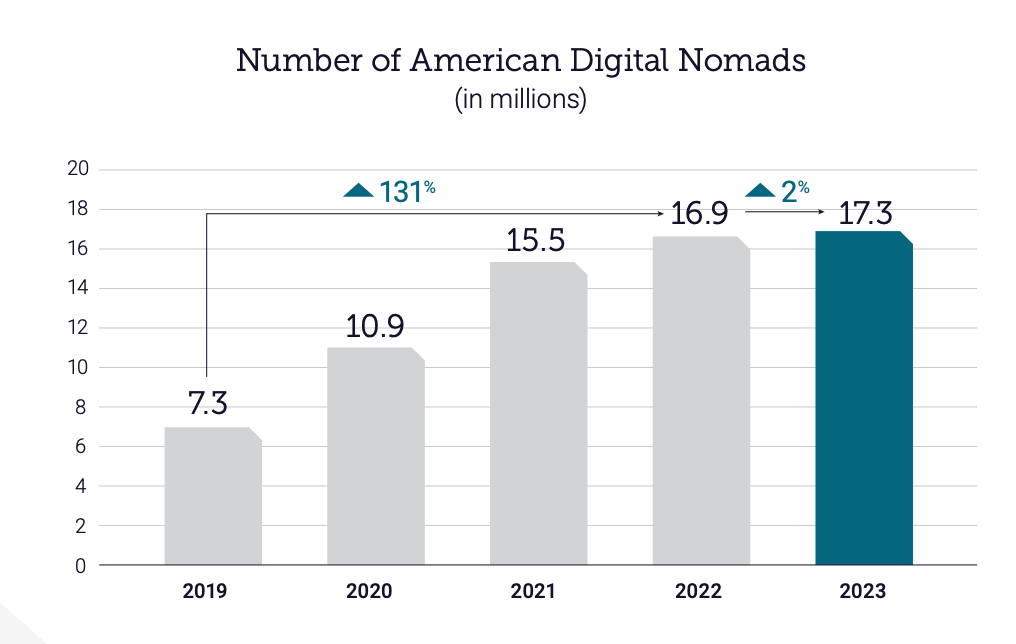
How many digital nomads are there? We have some indication of the demographics of digital nomads, although no official statistics exist to this date. Estimates place the number of digital nomads to several million. The State of Independence report published by MBO Partners showed that 17,3 million people in the USA alone identified as a digital nomad in 2023, a significant increase from 7,3 million individuals, who did so in 2019, prior to the pandemic.
How old are digital nomads? Digital nomadism is a trend commonly associated with the younger generations. Recently published Flatio report shows that the largest group of nomads are between 30 and 39 years old. Also, other reports place the largest number of digital nomads between the ages of 25 and 40.
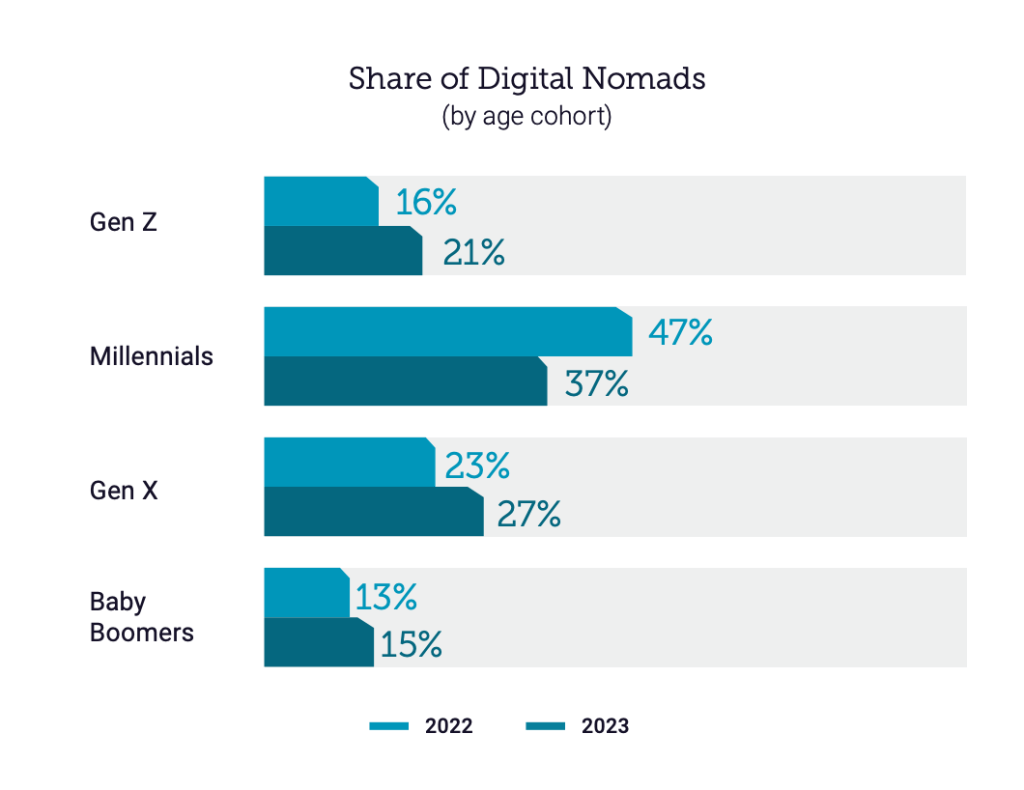
The State of Independence report also shows that the younger generations, Gen Z (21%, born 1997-2012) and Millennials (37%, born 1980-1996), comprise most digital nomads. Their overall share has been increasing since 2019. These generations are generally more IT-savvy and thought to have more location flexibility due to their life stage. A large majority of digital nomads do not have children and most also seem to be single, although the number of digital nomad families and couples has grown in recent years.

What else do we know of digital nomads? There are no official statistics collected by states on digital nomads. Below I highlight some statistics that I could locate from different websites that give some estimates on their gender distribution, country of origin, preferred destination countries, professional profiles, and so forth:
What do digital nomads do for work? Digital nomads work in a wide variety of fields. The main fields include IT and technology, media advertisement, creative services, PR and marketing, education and training, sales, finance and accounting and consulting, coaching and research. These professions are characterised by the possibility of remote work. Also, Flatio report shows that over a third of digital nomads hold full-time jobs (31.5.%), whereas the majority are freelancers (35%). Around 13.6% are entrepreneurs and business owners, and 6.8% are self-employed. Nomads are significantly more likely to be self-employed than their traditionally employed counterparts.
What impact did the Covid-19 pandemic have on digital nomadism? The Covid-19 pandemic is perhaps the single biggest impact on the growth of digital nomadism. Traditional workers (those employed full-time by a company) were unleashed from their offices, and many took to the road to embrace their location-independent work. The State of the Independence report shows that the number of digital nomads in the United States with traditional jobs grew from 3.2 million in 2019 to 10.7 million in 2023 (with 4% decline from 2022).

Although many workers have returned to the office, the modes of remote work are likely to persist. Depending on the flexibility of work arrangements, individuals will take part in digital nomadic mobility with diverse duration and frequency in the future.
Other interesting facts on digital nomads
- Why do people become digital nomads? The freedom from the office, location-independence, and the possibility to discover new places and encounter new people are listed as the most common reasons of choosing a digital nomad lifestyle. Also, the work-life balance among digital nomads seems to be much higher compared to non-digital nomads.
- What are the main challenges that digital nomads face? The most cited reasons seem to be getting tired of constant travelling, loneliness, lack of social relationships, personal safety, and difficulties in managing work. It is likely that many digital nomads settle down when they reach a certain age and start establishing families.
- Where do digital nomads travel and why? The most common destinations for digital nomads seem to be Portugal, Spain, Thailand, Indonesia, Colombia, Croatia, Bulgaria, Mexico and so forth. One of the most common reasons to travel to such destinations is the warm weather, low cost of living compared to their countries of citizenship and the existing digital nomad communities. Digital nomads take advantage of “geoarbitrage”, that is combining low-cost living with higher income. Earning salaries in euros, US dollars or British pounds gives digital nomads greater purchasing power in Global South countries. The digital nomads hold mostly passports of Global North countries, including the EU countries, Australia, New Zealand, Canada and the United States.
What shapes the future of digital nomadism?
- Remote work practices and technologies are likely to become more common.
- The meanings attached to work are changing, with workers now paying more attention to their work-life balance.
- The states and markets will increasingly accommodate digital nomadism. The services targeted to digital nomads will increase, namely digital nomad visa and e-residency programmes, co-working and co-living spaces and global nomad insurance schemes. As a result, new destinations will emerge as digital nomad hotspots.
- A diversification of digital nomad mobilities (part-time, full-time, temporary, permanent) is likely to occur, with individuals engaging in such mobilities with different duration, frequency and seasonality.
- Different sub-types of digital nomadism can also become more widespread. One example of such is the VanLife movement, the fastest-growing segment of digital nomads, who travel, live and work in RVs, vans or other vehicles converted into roaming residences.
Overall, digital nomadism is likely to continue its rapid growth. More recently, this has sparked discussions on to what extent digital nomadism is a sustainable lifestyle as well as on the impact such digital nomads have on local communities, who receive them.

References
Eurofund (2023) “Anticipating and managing the impact of change. The future of telework and hybrid work”. Report.
Flatio (2023) “Digital nomad report”. Report.
MBO Partners (2023) Digital nomads. State of Independence: Nomadism enters the mainstream. Report.
MBO Partners (2022) Digital nomads. Working from the road: The aspirations and reality for digital nomads. Report.
MBO Partners (2021) “The digital nomad research continues”. Research brief.
Kelly, H. et al. (2021) Work and wander: Meet today’s digital nomads. Report. Adventure Travel Trade Association (ATTA).
McKinsey Global Institute (2021) The future of work after Covid19. Report.
 DigiNomadProject